
Surroundings and space
Bringing nature into your home and workspace
How plants, natural light, materials and views of nature can lift mood and focus.
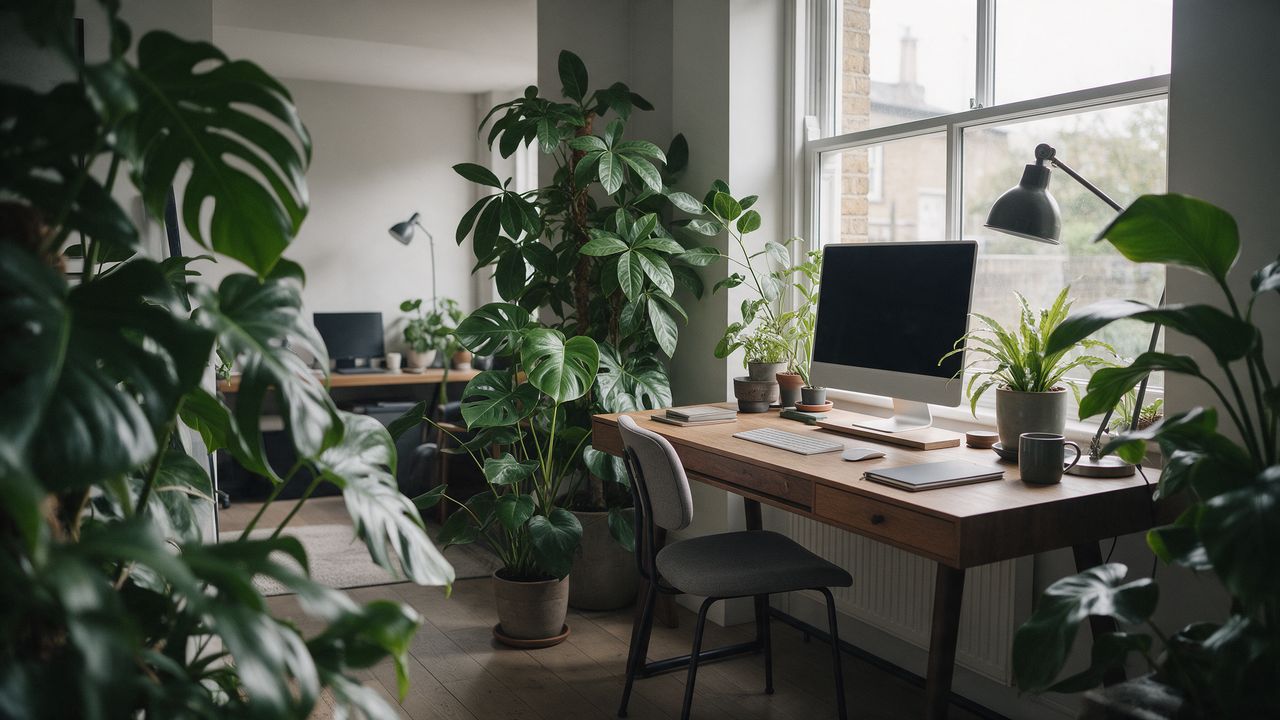
Picture two offices. One has grey carpet, strip lighting, beige walls and a view of a car park. The other has a few large plants, wooden furniture, natural light and a window looking out onto trees. Even without knowing anything else about them, most of us know which we'd rather work in.
The idea that we feel better around nature has a name: biophilia. The biologist E. O. Wilson popularised it in his 1984 book of the same name, arguing that humans have an innate need to connect with the natural world. Designers now use the term "biophilic design" for bringing natural elements into buildings.
What the research shows
A view of trees. In a well-known 1984 study, environmental psychologist Roger Ulrich looked at patients recovering from gallbladder surgery in a US hospital. Patients whose windows looked out onto trees had shorter hospital stays and needed fewer strong painkillers than similar patients whose windows faced a brick wall.
Plants at work. In a 2014 study, Marlon Nieuwenhuis, Craig Knight and colleagues at the University of Exeter added plants to previously bare offices. Over the following months, workers in the "green" offices reported feeling more satisfied and better able to concentrate, and their productivity rose by around 15%.
What plants don't do
You may have heard that houseplants clean the air. This claim often goes back to a 1989 NASA study, which tested plants in small, sealed chambers. In a 2019 review, Bryan Cummings and Michael Waring at Drexel University calculated that you'd need somewhere between 10 and 1,000 plants per square metre to match the air-cleaning effect of normal ventilation. In an ordinary home or office, plants make very little difference to air quality.
That doesn't mean they're not worth having. The benefits for mood and focus seem to come from having living things around us, not from cleaner air. For fresher air, open a window.
Ways to bring nature in
Plants. Choose a few that suit your space and the amount of light it gets. If you're not confident with plants, try hardy ones like snake plants, pothos, spider plants or ZZ plants. A few large plants often have more impact than lots of tiny ones.
Natural light. Position your desk or favourite chair near a window if you can. Keep windows clean and blinds open during the day.
A view. If you have a window with a view of trees, sky or gardens, face it, or at least angle yourself so you can see it.
Natural materials. Wood, stone, wool, cotton and linen bring a sense of nature into a room. A wooden desk, a woollen throw or a stone coaster all count.
Natural colours and patterns. Greens, blues, earthy browns and patterns that echo nature, like leaves, waves or wood grain, can make a space feel calmer.
Fresh flowers or foraged finds. A jar of flowers, a branch of autumn leaves or some pine cones on the windowsill.
Nature images. If you don't have a view, a picture of a forest, a beach or mountains is better than a blank wall. Research suggests even images of nature can have a small positive effect on mood.
Sound. Some people find recordings of rain, birdsong or waves helpful, especially in noisy offices.
Make it part of the routine
Habit researcher Wendy Wood has found that habits stick best when they're tied to stable cues. If you add plants, link caring for them to an existing routine, such as watering them every Monday morning before you open your laptop.
Get outside too
Bringing nature indoors is helpful, but it's no substitute for going out into it. Berkeley psychologist Dacher Keltner's research on awe walks found that people who spent short weekly walks noticing the world around them reported more positive emotions over time.
The Norwegian idea of friluftsliv, or "open-air living", is a good reminder to make time outdoors part of daily life, whatever the weather.
This week
Make one change to the space where you spend most time: add a plant, move your chair nearer the window or bring in something natural, like flowers or a piece of wood. Notice how the space feels by the end of the week.