
Energy, sleep and recovery
Three ways to breathe yourself awake
Energising breathwork techniques, with safety notes.
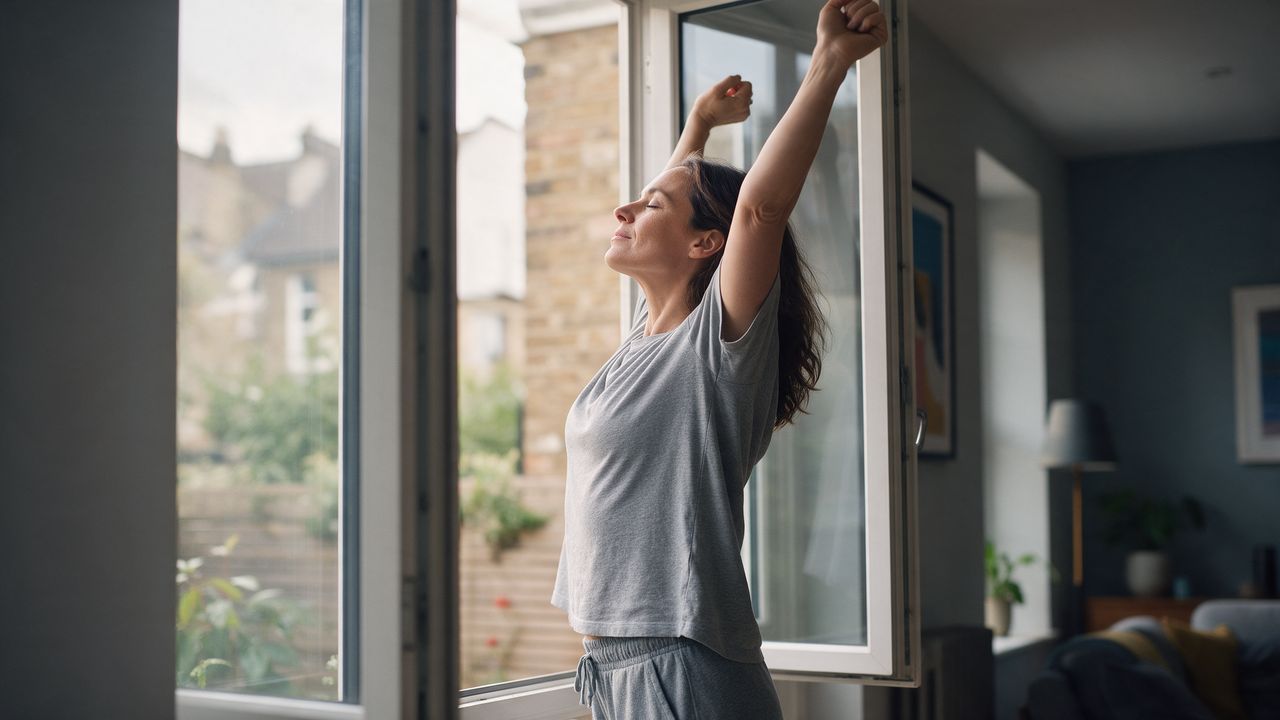
Most breathing exercises you hear about are designed to calm you down. Slow breaths, long out-breaths, relaxing into the moment. That's useful when you're stressed. It's less useful at 2.30pm when you need to stay sharp for a meeting, or first thing in the morning when your brain hasn't caught up with your body.
Breathing can also be used to wake you up. Here are three ways to do it.
A quick word on safety
Energising breathing involves breathing faster or more forcefully than usual. Done for short periods, it's safe for most people. But:
- stop if you feel dizzy, light-headed, tingly or unwell
- never do fast breathing exercises in water, while driving, or anywhere fainting could be dangerous
- avoid them if you're pregnant, have epilepsy, a heart condition, high blood pressure or a history of panic attacks, unless you've checked with your doctor
Keep each round short, and breathe normally in between.
Why breathing can energise you
The way you breathe sends signals to your nervous system. Slow breathing with a long out-breath activates the calming side. Faster breathing, and breathing that emphasises the in-breath, nudges the body towards the more alert, active side.
The research here is less developed than for calming techniques, but there is some. A 2023 Stanford study comparing several five-minute daily breathing practices found that a technique involving faster breathing, called cyclic hyperventilation, improved people's mood and energy, though less than a slower technique did. So these are tools for short boosts, not something to do for long periods.
1. Breathe in longer than you breathe out
This is the gentlest option, and a good place to start.
- Sit or stand tall, with your shoulders relaxed.
- Breathe in through your nose for a count of four.
- Breathe out through your mouth for a count of two.
- Repeat for about a minute.
Flipping the usual calming pattern, so the in-breath is longer, tends to feel more invigorating.
2. Breathing with movement
Combining breath and movement is one of the most reliable ways to wake yourself up, because the movement does a lot of the work.
- Stand with your feet hip-width apart and your arms by your sides.
- Breathe in through your nose as you sweep your arms out and up above your head.
- Breathe out through your mouth as you lower them back down.
- Repeat ten times, at a steady but brisk pace.
You can add a gentle rise onto your toes as your arms go up for a bit more effort.
3. Quick, sharp out-breaths
This technique is based on a yoga practice called kapalabhati, sometimes known as "skull-shining breath". It's the most energising of the three, so keep it short.
- Sit upright and take a normal breath in.
- Breathe out sharply through your nose, pulling your belly in quickly as you do. Let the in-breath happen on its own as your belly relaxes.
- Repeat at about one breath per second, for 10 to 15 breaths.
- Then breathe normally for a minute.
If it feels like too much, slow down or stop.
Make it easy to remember
Stanford behaviour scientist BJ Fogg says a behaviour happens when motivation, ability and a prompt come together. When you're feeling flat, motivation is low, so the technique has to be easy and the prompt clear.
Pair it with something you already do, using Fogg's formula "After I ___, I will ___":
- After I get out of the shower, I'll do ten arm sweeps.
- After I get back from lunch, I'll do one minute of longer in-breaths.
- Before an afternoon meeting, after I open my laptop, I'll do 15 sharp out-breaths.
Try it now
Stand up and do the arm sweeps ten times. Notice how you feel compared with a minute ago.