
Why a lazy day can leave you exhausted
Explains how inactivity, boredom and low mood drain energy, and why gentle movement helps.
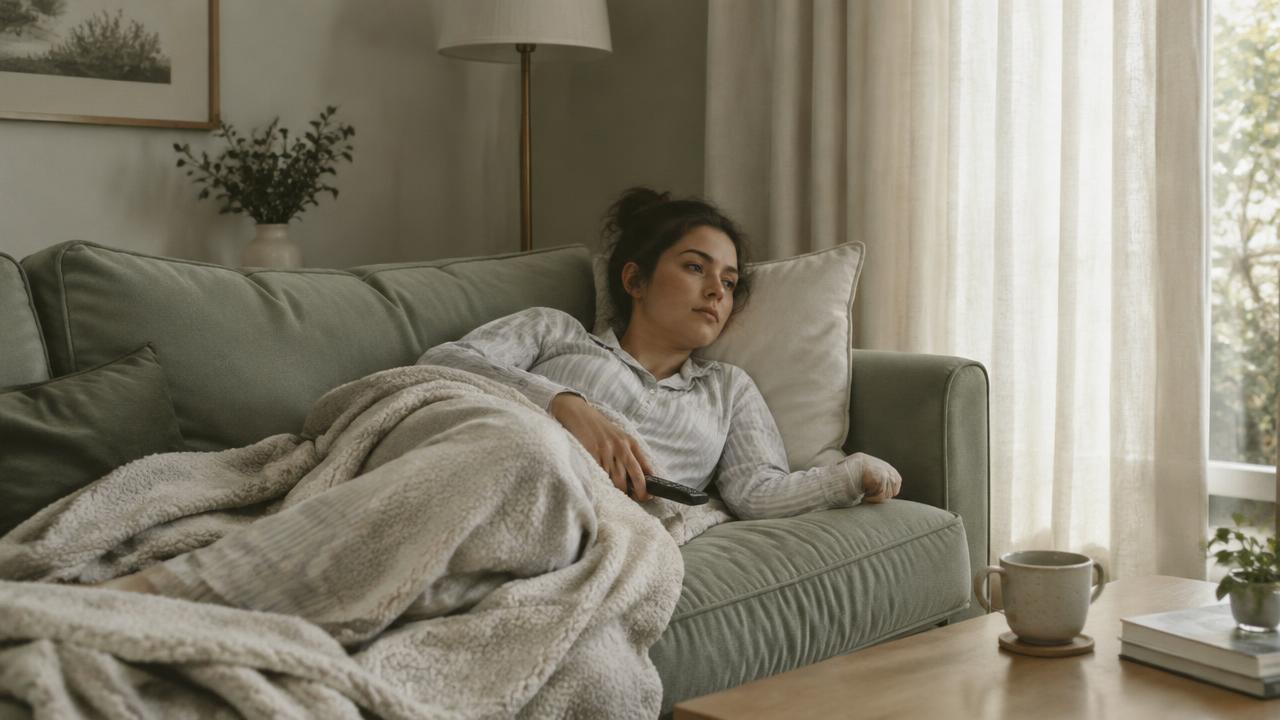
You'd been looking forward to it all week. A whole Sunday with nothing planned. You stayed in your pyjamas, watched films, ate when you felt like it. By 6pm you felt heavy, foggy and oddly flat, more tired than you'd been on Friday.
This is one of the more annoying things about energy. Doing nothing doesn't always recharge us. Sometimes it drains us further.
Your body takes the hint
When you spend a day mostly still, your body adjusts to the demand. Circulation slows, muscles stay slack and your breathing stays shallow. Less oxygen-rich blood reaches the brain, and you feel sluggish. If you also slept in much later than usual, your body clock gets a confusing signal about when the day started, which can leave you groggy for hours.
Then there's boredom. A mind with nothing to engage it doesn't feel restful, it feels restless and dull. Psychologists describe boredom as a state of low arousal combined with a wish for something to happen. It's surprisingly tiring.
Low mood plays a part too. Long stretches of inactivity can nudge mood down, and low mood makes everything feel like more effort, so the sofa gets more appealing. It becomes a loop.
Movement gives energy back
It seems unfair that the cure for tiredness is to use some energy, but the evidence is fairly consistent. In a well-known study at the University of Georgia, sedentary adults who reported persistent fatigue did twenty minutes of gentle cycling three times a week. After six weeks, the low-intensity group reported their fatigue had dropped by about 65%. They weren't training hard. They were just moving.
Gentle movement increases blood flow, lifts alertness and gives the brain a change of input. It also tends to improve mood, which breaks the loop.
We're bad at predicting this
If movement helps so much, why does the sofa always win? Part of the answer is that we're poor at predicting what will make us feel good. Yale psychologist Laurie Santos often talks about this. We expect that resting on the sofa will feel lovely and that a walk will feel like a chore, and we're often wrong on both counts. The walk is rarely as bad as we imagine, and the afternoon on the sofa rarely leaves us as rested as we hoped.
Make it easy to start
Stanford behaviour scientist BJ Fogg says a behaviour happens when three things line up: motivation, ability and a prompt. On a slow, low day, motivation is at rock bottom, so the trick is to make the action so easy that you don't need much of it, and to give yourself a clear prompt.
Instead of "I should go for a run", try "When the kettle boils, I'll walk to the end of the road and back". Short, simple and tied to something you're already doing. Often, once you're outside, you'll keep going. If you don't, you've still done more than nothing, and that counts.
A better lazy day
Rest days are important, and this isn't an argument for filling every weekend. A better lazy day just has a bit of variety in it.
- Get up within an hour of your usual time, even if you go straight back to the sofa.
- Open the curtains and get some daylight in the first part of the day.
- Build in two short bursts of movement, ten minutes each, perhaps a walk, a bit of tidying, or dancing in the kitchen.
- Swap one screen session for something that uses your hands or your head: cooking, a puzzle, a phone call.
Next time you plan a day off, try this mix. You may find you end the day feeling like you've actually rested.
Where to get support If you feel exhausted most of the time for more than a few weeks, even with rest, speak to your GP. Ongoing tiredness can have physical causes, such as anaemia or thyroid problems, that are worth ruling out.